The road out of Ouray was empty and dark, gravel gone silver where the rain had already been at it, and the canyon walls above Camp Bird held the last of the night in their creases like something they weren't ready to give up. No headlamps ahead of me, no taillights behind. Just the sound of tires finding washboard and the heater fighting a losing battle against the window fog.
I have wanted one particular photograph from this basin for years, and it has nothing to do with columbine. Everyone comes for the wildflowers in July, myself included, more than once, kneeling in the paintbrush like it owed me something. What I actually wanted was the basin holding both seasons at once, green slope and first snow and the aspens just starting to go, all in the same frame, Sneffels standing over it like it had agreed to pose. That day never lines up. The wildflowers finish, the light gets ordinary, and then it snows and the road closes before anyone with a camera gets a vote.
The forecast the night before said rain, which at nine thousand feet in Ouray meant nothing definite. Rain down here could be snow up there, and I have built entire trips on that kind of arithmetic before and been wrong about half the time. I told myself this was the year the numbers would work out. I have told myself that in past Septembers too, with the same tripod riding shotgun and the same unreasonable confidence.
I remember one September, two years back now, when I made it exactly this far up Camp Bird and turned around at the first switchback because the rain had gone to sleet and the shoulder had gone to nothing at all. Another year I never left Boulder, watched the radar for three days, and talked myself out of the drive entirely, which in hindsight was probably the correct decision and remains one I regret. This year I had decided, somewhere around the second cup of coffee at four in the morning, that regret was the worse of the two options.
The climb past the old mill sites was slow, the kind of slow where the wipers earn their keep and the cloud ceiling sits low enough to touch the hood. I had rented a small SUV that called itself high clearance in the same optimistic way I call myself an early riser. It managed, mostly, by refusing to hurry, which suited me, since hurrying up that road has ended in bent rims for better drivers than me.
Somewhere past the second switchback the cloud thinned to a kind of gauze, and for maybe forty seconds I could see a wedge of gray rock above the basin rim before the weather closed it again like a hand over a candle. That was the whole of the show for a while. I sat with the engine idling and waited, which is most of what this kind of photography turns out to be, waiting dressed up as driving.
I kept the radio off the whole way up, partly because the reception had given up somewhere below the mill, partly because I like to hear the road under the tires when it is this rough, the small grinding conversation between gravel and rubber that tells me more about traction than any dashboard light does. A pair of ravens crossed low over the windshield at one point, unbothered by either the weather or me, which felt like a small correction to my sense of how urgent any of this actually was.
Then the ceiling lifted for real, all at once, the way it does at elevation when the wind finally finds the right angle, and there was Sneffels, green slopes below the summit and old snow patches holding on in the shaded folds, under a sky that had apparently decided to be blue for a while out of pure spite toward the forecast.

The peak came clear for a stretch of clean morning light, snow patches still holding in the shadowed folds below the ridge.
I got out, which felt like a small victory, and stood there without the camera up for a moment longer than I should have, just looking, before I remembered what I had driven three hours to do.
The road leveled into the lower basin and the first aspens showed up along the shoulder, not the whole hillside gone gold the way it gets in late September, just a scattered handful of trees that had apparently decided to get an early start on the season without consulting the rest of the stand. Against the snow-dusted rock behind them they looked almost staged, which is a strange thing to think about a tree that has no idea it is being photographed.

A few early aspens along the gravel, gold ahead of schedule, with the peaks behind them already carrying a first dusting of white.
The wildflowers were finished, obviously, three months late for those, the columbine reduced to dry stalks and the paintbrush gone the color of old rust. It is a strange kind of homesickness, standing in a place that gave you something extraordinary once and now hands you the aftermath instead. I did not mind it as much as I expected to. There is a particular satisfaction in seeing a place off its best behavior.
I thought of a July morning years ago, the one time the bloom and the light both cooperated, when I knelt in wet grass with a waterfall going somewhere behind the frame and could not decide which flower to kneel in front of because every direction was an argument for itself. That morning is the one the basin is famous for, and it is a real thing, not an exaggeration built up by people who have never stood in it.

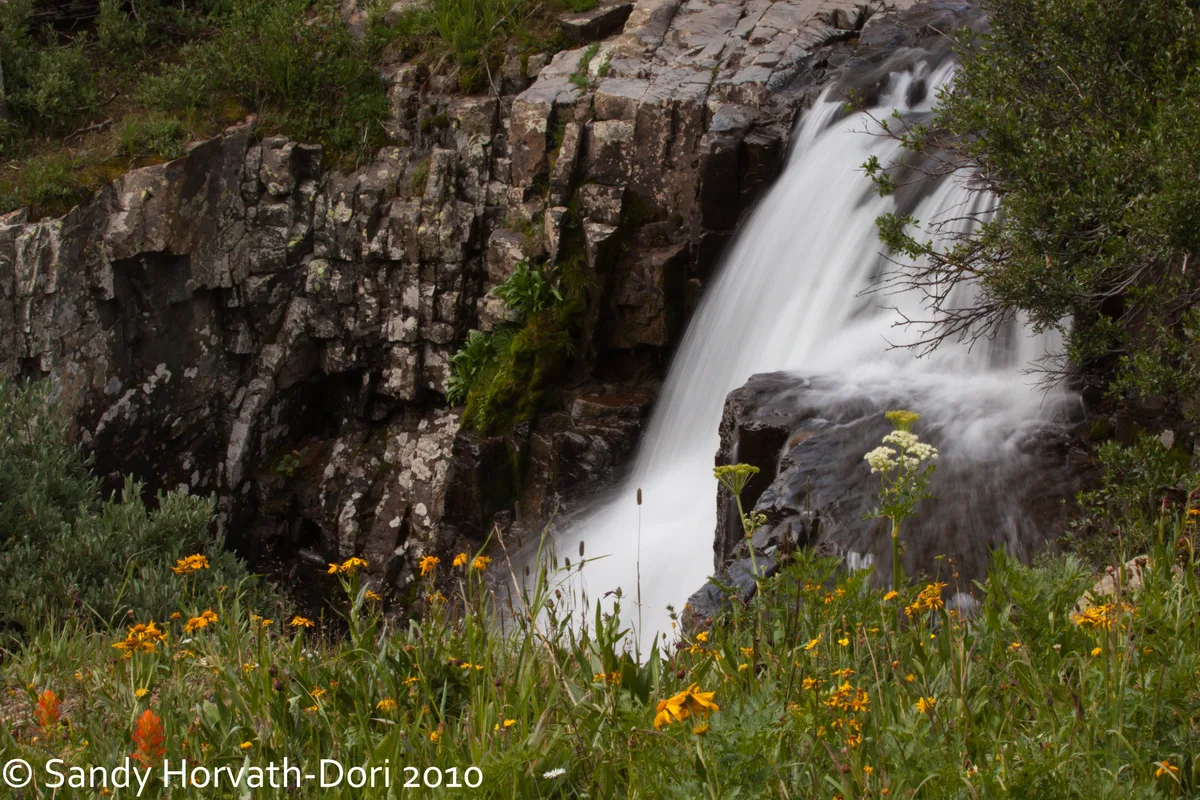
From a July visit years back, the basin lush and full, a small waterfall threading down through spruce below the same ridgeline.
The ruins themselves sat a little further up the slope, a scatter of gray timber and rusted cable that had given up trying to look like a building decades ago. A chute of some kind, half collapsed, still pointed downhill at nothing in particular, and a square of foundation stone had gone soft at the corners the way old mortar does at this elevation, freezing and thawing itself into rubble one winter at a time. I did not photograph the ruins closely. They looked better as a suggestion at the edge of a wider frame, half forgotten the way the light usually finds them.
I got the tripod out of the back for the first time in what felt like a month, more out of habit than plan, and left it standing there half assembled while I chased the light with the camera in hand instead, because the light was moving too fast to wait for legs to be leveled.
The upper basin road turned to a kind of clay soup about a mile short of where I wanted to be, the exact stretch where the practical notes about high clearance stop being theoretical and start being personal. I got out and walked the rest, boots sinking a little with each step, breath shorter than it should have been at a pace that would have been nothing at sea level.
About ten minutes into that walk the rain that the forecast had promised finally arrived, not dramatically, just a fine cold mist that settled on the camera bag and made me wish I had brought the rain cover instead of leaving it, characteristically, in a drawer in Boulder. It was the kind of rain that does not soak so much as accumulate, and by the time I reached the spot I wanted, my jacket had gone from resistant to merely damp, which felt like a fair trade for what came next.
From that spot I had almost the shot. Sneffels stood clear for a run of maybe ninety seconds, snow bright on the upper rock, a thin gold line of aspen below it, green slope filling the middle distance exactly where I had always pictured it. I had the wrong lens on. I changed it with hands that were colder than the temperature explained, and by the time I had the right glass up the cloud had come back over the ridge like a lid going back on a pot.
I have chased this exact alignment for three Septembers now, at three different elevations of hope. This was the closest I have come, and closest is a word that does a lot of quiet work in a sentence like that.

Wildflowers long gone by this date, but the same slope holding the light the way it does in every season, rocky and rising toward the ridge.
On the way out the light went flat and gray the way it does once the morning window closes, and the cold air that had been sitting in the low folds of the basin all night came up to meet the truck like it had been waiting for company. The spruce along the lower road smelled sharp and wet, that particular resin smell that only shows up after rain, and for a while that was worth more to me than any photograph would have been.
I stopped in town for coffee at a diner with steamed-up windows and a bell over the door that announced me to no one in particular. The waitress asked if I had gotten my picture, in the easy way people in that town ask, having seen a hundred cameras come down off that road looking either satisfied or sheepish. I told her I had gotten most of it, which seemed like the honest answer, and she nodded like she had heard that exact sentence before.
The tripod rode home in the back seat exactly as unopened as it had been on the way up, legs still half extended from the one time I had bothered with it, which is roughly its usual condition. I have started to think of it less as equipment and more as a kind of ballast, something I bring along to prove to myself that I am serious.
I did not get the photograph I had been carrying around in my head for three years. I got something close enough to keep, and a clear idea, finally, of exactly which ninety seconds I am waiting for next September, weather willing, road willing, and my own timing, for once, willing to cooperate.