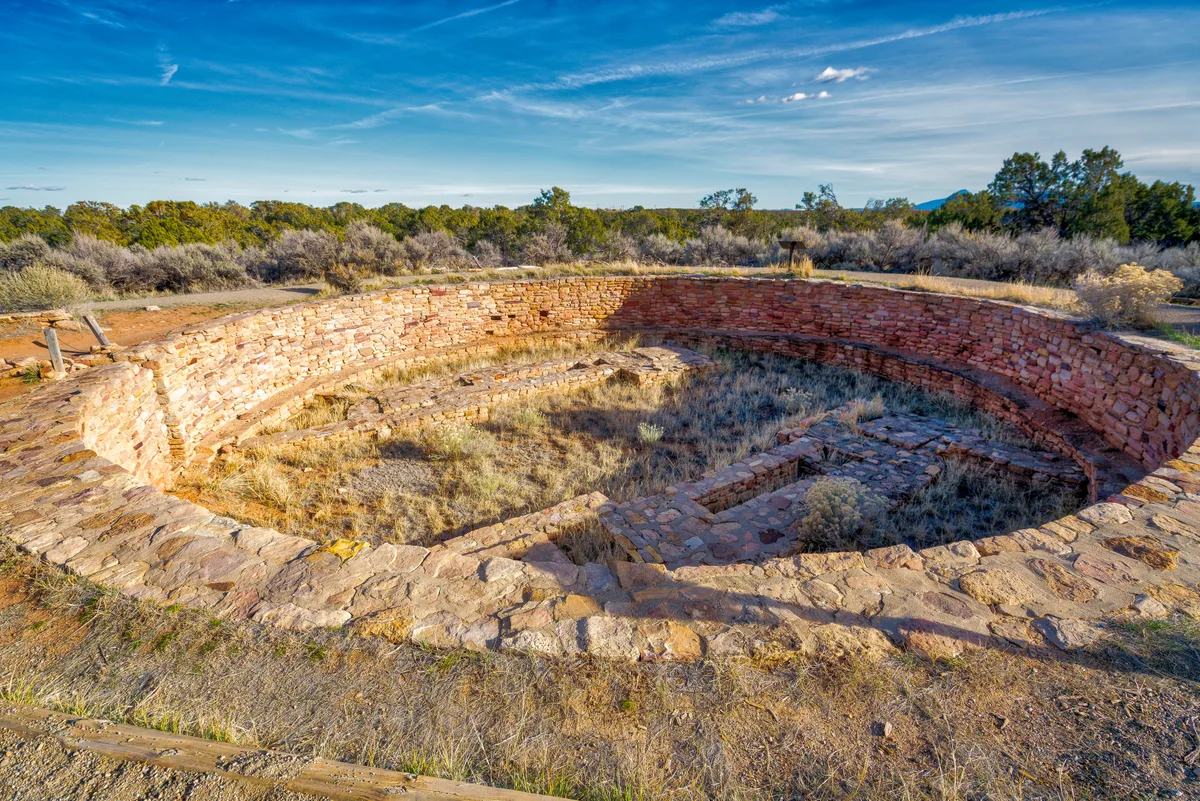
Lowry Pueblo sits where it has always sat, on a flat run of sagebrush west of Pleasant View, and I stood at the edge of the great kiva again with the light going low and orange across the stone. I had not planned to feel anything in particular. I had only driven out to see if the plaster was still there, the way it was the first time, faint red and white against the curve of the wall. It was. But something in me had gone quieter than the last visit, and the quiet of the place matched it too well, the way stone can hold a mood back without meaning to.
The wind had dropped to almost nothing. A grasshopper moved through the sage somewhere to the left, and that was the only sound for a long while, that dry ticking, and then even that stopped. The sky held a few high clouds left over from the afternoon's storms, but the storms themselves had passed south, over toward the Ute Mountain country, and what remained was a sky scrubbed pale and a sun dropping toward Sleeping Ute in a way that made the whole plain look briefly gold.
The day had been hot, ninety-six by midafternoon according to the radio out of Cortez, and I had watched the clouds pile up over the mesas to the south while I sat in the shade of the car, certain the afternoon would bring the kind of storm that closes the plain down for an hour. It never reached this far north. By four the anvils had drifted off toward the reservation and left the sagebrush under nothing but heat and a sky gone the color of old glass. I drove out anyway, gambling on the evening the way I always do out here, knowing the light after a near-storm can be better than the light before one.
I had come out from Cortez in the late afternoon, taking the long straight run on County Road CC that gives nothing away and then, all at once, gives everything. There is no gate at Lowry, no fee station, no one to ask where to walk. Just a small trailhead with a paper guide in a metal box, and the ruin ahead on the rise, low walls the color of the ground they sit in. I remembered that part exactly. The drive had not changed. The road still ran through the same wide nothing, heat shimmering off it at midday, cooling now toward evening.
The guide in the metal box was newer than the one I remembered, its corners not yet curled by weather, and I took one anyway out of habit though I did not open it until I was back at the car hours later. The first time I had read it standing at the trailhead, eager, checking each numbered stop against the map as though something might be lost if I did not. This time I let the ruin explain itself as I went, or not explain itself at all, which felt closer to how a thousand-year-old place probably wants to be met.
Archaeologists worked this ground in the early part of the last century, and again decades later, uncovering room after room of the great house a little at a time, careful the way that kind of work has to be careful. Ninety years of building lay under my boots, one generation adding to what another had raised, kivas dug and redug, walls squared and resquared. None of that labor showed itself as labor anymore. It showed itself the way weather does, as something the land had simply decided to keep.
I came here first several years ago, in September, at nearly this same hour of light. I remember I had the site to myself then too, and I remember thinking that solitude was the gift of the place, that no one else seemed to want it enough to drive the extra hour. I was younger in a way that had nothing to do with age. I photographed everything too quickly that day, wide shots first, hurried, the obvious angles, because I did not yet know how to be still in front of something that had already been still for a thousand years.
This time I did not hurry. I walked the low walls first without lifting the camera at all, letting my eyes adjust to how the rooms fit together, forty of them once, thin partitions of stone now no higher than a knee in most places. The sagebrush had grown up close to some of the walls since I was last here, softening lines that had been sharper before. I could not tell if that was a season's growth or years of it. Either way it read like something the place was slowly taking back.

The masonry spread low and warm across the hillside, room outlines running out toward the tree line, the sky above it a hard clean blue that would not last the hour.
The great house held the last of the direct sun while the ground around it had already gone to shadow, and for a while the walls looked lit from within, some old ember still caught in the stone. I thought about the people who built this, over ninety years of building, generation folding into generation, and how strange it was that their care survived so plainly while so much of what I had cared about in the years between my visits had not. A friendship gone quiet. A place I used to shoot every fall now changed past recognition by fire. The pueblo did not know any of that. It only kept doing what it had always done, holding the light a little longer than the land around it.
The heat of the day let go all at once, the way it does out here once the sun drops behind the mountain's shoulder. I felt it first at my ankles, a thread of cooler air moving through the sage, and then it rose past my knees until the whole plain seemed to exhale. Ninety-six degrees had become something closer to sixty within an hour, and I was glad of the jacket I had almost left in the car. August nights out here still carry an edge of the season's turning, even with weeks of heat left to come.
The great kiva was the part I had come back for, though I had not admitted that to myself until I was standing over it. I remembered descending the steps the first time and feeling my chest go tight at the painted plaster, the way it seemed too fragile to have lasted, a memory painted onto the interior of the earth. This time the paint looked fainter, or my eyes were less generous, or both. I sat on the rim a long while instead of going down, watching the shadow of the wall creep across the floor of the pit.

The kiva lay open and quiet in the sun, its rim holding one seated figure at the edge, the rest of the plain running off pale and empty behind it.
No other vehicle came down the county road the whole time I stood there, not the pickup I half expected, not even the dust of one far off. The solitude that had felt like a gift on my first visit felt like something closer to an ache this time, and I could not decide if the place had changed or if I had simply brought a different self to stand in it. Either way the sagebrush did not care, and the walls did not care, and there was a kind of mercy in that indifference.
I missed things the first time that I noticed now. The way a doorway low in one wall framed nothing but sage and distant mountain, a small rectangle of the world held still. The way the site's silence was not empty but layered, wind and grasshopper and the far-off tick of an engine cooling somewhere out past the trailhead, though I never saw the truck itself. I had been in too much of a hurry before to hear any of that. This time the hurry was gone, replaced by something heavier that made slowness easy, almost inevitable.
The light kept dropping in small increments, each one taking something from the scene and giving something else. The reds went deeper. The shadows off the low walls stretched until they touched other shadows and the whole ruin seemed to knit itself together in silhouette. A path ran out from where I stood toward a smaller cluster of rooms, a solitary shrub breaking the line of it, and a dark doorway held its own private dusk even while the sagebrush around it still caught the sun.

The path led out across the plain toward a low doorway already gone dark, one shrub standing alone beside it in the last full light.
I thought, sitting there, about how much of what draws me back to places like this is not the place at all but the earlier version of myself I left there. That September evening lives somewhere in me still, whole and a little idealized, and I keep returning to these plains half hoping to meet her again among the walls. She is not there, of course. Only the walls are there, patient in a way I have never managed to be.
The sagebrush released its smell as the air cooled, sharp and a little bitter, mixing with the drying grass and the faint mineral scent that rises off old stone at the end of a hot day. Sleeping Ute went from blue to violet to a color with no easy name. I did not photograph that last part. Some things I have learned to just watch.
By the time I walked back to the car the sun had gone below the mountain's long profile and the plain had turned the flat gray of early dusk. I stood a moment with the door open, not ready yet to leave, listening to the last of the heat ticking out of the hood. No truck passed this time, not one, the whole two hours I was there. The road home ran straight and dark toward Cortez, and behind me the pueblo settled back into whatever quiet it keeps when no one is left to watch it.